
Learning the standard kitchen cabinet size will ensure your cabinet fits nicely with your kitchen layout. Kitchen cabinets come in different sizes, and this article will tell you all about the usual sizes of kitchen cabinets to help you plan your kitchen easily.
Base Cabinet Standard Dimension
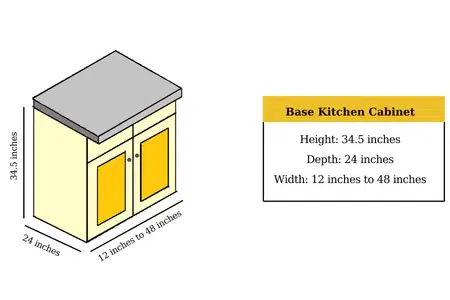
1. Height
The usual height without a countertop for the base cabinet is 34.5 inches (approximately 87.63cm). This is an ergonomic height for people to prepare food in a comfortable position.
If you are taller or shorter, or if someone in your family uses a wheelchair, you can ask for cabinet suppliers to customize it into a little higher (up to 38 inches) or lower (down to 32 inches) to keep efficiency in the kitchen while keeping workspaces safe and accessible.
2. Depth
The base cabinet’s normal depth, without a countertop, is twenty-four inches (60.96 cm). After the countertop is included, the depth will be 25 to 26 inches. This slight overhang protects the cabinet from being scratched and provides extra space for food prep and setting small appliances.
3. Width
The width of base cabinets can change a lot, from a small 12 inches to a wide 48 inches. The size you need depends on how big your kitchen is and how much stuff you want to store. You can find there are some regular sizes in the market, such as 12 inches, 18 inches, 24 inches, 30 inches or even 48 inches. Choose the narrow size cabinet if your kitchen’s layout is small. If you have a big kitchen, you can have wider ones for lots of storage.
Design Tips for Base Cabinet Size
When you pick the size of your base cabinets, think about what you’ll use them for.
If you want a single sink for a unbusy kitchen, the cabinet should be at least 30 inches wide. If you want a double sink (two sinks side-by-side) to have more washing area, you’ll need a wider cabinet, at least 36 inches.
Also, remember that the depth of the cabinet affects how much you can store inside. A deeper cabinet can hold bigger pots and pans.
Standard Size for Wall Cabinet

1. Height
The standard height is 24 inches. You can find there are many height options, including shorter options such as 12, 15, and 18, and higher options such as 30, 36, and 42 inches to store more kitchen stuff. Please make sure there are 15 to 20 inches between the countertop and the bottom of the wall cabinet to ensure there’s enough room to place appliances.
2. Depth
Standard depths start at 12 inches for light items like dishes and glasses, which is a good size for storing dishes and glasses without them sticking out too much. Try to use a deeper cabinet, such as 15 or 18 inches, if you’re going to store more kitchen supplies. Consider using 24-inch-depth wall cabinets if you want to build in some big kitchen appliances into wall cabinets.
3. Width
You can find them from a narrow 12 inches up to 36 inches wide. Sometimes, you might even see them as small as 9 inches, you will also find a wider one like 48 inches. They usually go up in steps of 3 inches, like 12, 15, 18, 21, and 24 inches. Choose the width that fits your kitchen layout and how much stuff you need to put away.
Tips for Wall Cabinet Design
When you plan your wall cabinets, think about how high your ceiling is.
If you have tall ceilings, you might want to use taller cabinets or stack two cabinets on top of each other. Also, if you have decorative molding at the top of your walls (crown molding), you need to make sure your cabinets fit nicely with it. If you want to have a uniform and even look, make sure the wall cabinet has the same depth as your refrigerator.
Tall Pantry Cabinet Dimensions
Tall cabinets stand from the floor to the ceiling. They are great for storing lots of food, cleaning supplies, or even appliances. We’ll talk about three key areas: height, depth, and width.
1. Height
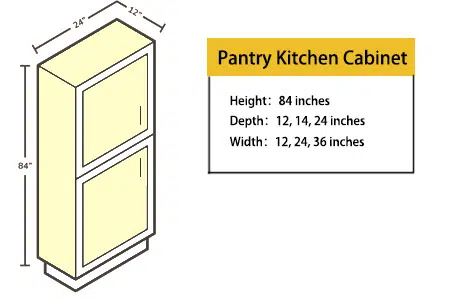
Tall cabinets usually have two parts. The bottom section is about 54 inches tall, while the top section can be either 36 or 42 inches tall. This split allows for ample storage space and flexibility. The two-part design supports both heavy items at the bottom and lighter or frequently used items at the top. It offers practical storage solutions without compromising on style or ease of access.
2. Depth
The depths of 12 inches and 14 inches are the most common depths for tall cabinets. You can use a 12-inch-depth tall cabinet to store canned goods or small appliances for an organized kitchen. In contrast, a 24-inch depth provides space for larger appliances or larger kitchen stuffs. Make the choice according to your storage needs and kitchen layout.
3. Width
For a tall pantry cabinet, 24 inches (60.69cm) is average and standard depth, which offers enough storage room while keeping your kitchen from looking crowded. If your kitchen is narrow or requires a filler for the gap between larger units, try to consider 12-inch cabinets. A 36-inch width works best for cooking chaser or large families.
Tips for Tall Cabinet Design
Tall cabinets often come in two pieces that you put together. A common size for a pantry (a cabinet for food) is 24 inches wide, while 36 inches wide is often used to pair with pull-out shelves. When you have wall cabinets above your countertop, try to make your tall cabinets the same height for a balanced look.
As an example to explain, if you already have a wall cabinet 24 inches in height, you should make a 60-inch-tall pantry for the bottom part and 24 inches for the above part. It’s also a good idea to make tall cabinets go all the way to the ceiling to keep dust out and make your kitchen look bigger.
Specialty Cabinet Size
- Corner Cabinet Size
Corner cabinets typically stand at 34.5 inches in height, with a width between 33 to 36 inches and a depth of 24 inches.
- Diagonal and Blind Corner Cabinet Size
The standard dimensions for diagonal and blind corner cabinets are width 36 inches, depth 24 inches, and height 34½ inches. This kind of special design helps to maximize the use of space while keeping items within reach, making them popular for many kitchens.
- Kitchen Island Base Cabinet Size
Kitchen island base cabinets are commonly 36 inches in height, 24 inches in depth. For width, you can find more options, including 30, 35, 48, and 60 inches. These cabinets support both food preparation and seating areas on the island.
- Lazy Susan Cabinet Dimensions
The standard lazy Susan cabinet is 34½ inches in height, 33 to 36 inches in width, and 24 inches in depth. This kind of cabinet design allows for smooth rotation, giving you easy access to items stored in the back.
Tips for Measurement
Before you get new cabinets, it’s important to make a measurement for your kitchen.
Tools for Measurement
You need to prepare a few simple tools to measure:
- Measuring tape
- Pencil to mark down
- Paper to write down the measurements
How to Measure Your Cabinet?
- Width: Measure the width of the cabinet front from side to side at least 3 times.
- Height: Measure from the bottom of the cabinet to the top at least 3 times.
- Depth: Measure from the front to the back of the cabinet at least 3 times.
Other Tips:
- Do not forget to check the interior space for shelves. Write down each measurement for accuracy.
- When recording data, please clearly mark the length unit to avoid buying the wrong size cabinets. You will see there are some supplier measurements in centimeters (standard kitchen cabinet sizes in cm) or millimeters (standard kitchen cabinet sizes in mm).
Conclusion
After fully reading the standard size of kitchen cabinets, you’re ready enough to make accurate measurements and good design choices to ensure that your cabinets are stylish and functional.
If you want to bespoke cut-to-size kitchen cabinet to fit your kitchen layout, AJ Flying is your option.
FAQs
1. Standard distance between countertop and wall cabinet
18 to 20 inches is the common distance between the countertop and wall cabinet. This distance can balance your visual and storage needs.
2. Whether standard dimensions of kitchen cabinets universal?
No, kitchen cabinets come in different sizes. While there are standard sizes, custom cabinets can be made to suit specific kitchen layouts and your needs.
3. The Idea Space That Should It Leaved Between Ceiling And Wall Cabinet?
Try to leave a gap of about 2 to 4 inches between the top of the wall cabinet and the ceiling. This space allows for airflow, you can also clean it easily.
4. Common Size of Appliances
Below is a chart listing the standard dimensions of common kitchen appliances. Please note that these sizes are typical guidelines; It may slightly differ with the manufacturer.
| Appliance | Width (inches) | Height (inches) | Depth (inches) |
| Refrigerator | 36 | 70 | 30 |
| Range/Range Hood | 30 | 36 (range) / 18 (hood) | 25 (range) / 22 (hood) |
| Built-In Oven | 24-30 | 28 | 24 |
Related Resouces
1. Average Kitchen Size – AJ Flying
2. Standard Kitchen Sink Size -Kallista
3. Countertop Height and Depth – AJ Flying
 English
  German
  French
  Spanish
  Portuguese
  Turkish
  Dutch
Dutch