
Introduction
A well-organized kitchen will help you reduce running back and forth across your kitchen while cooking. In this guide, we’ll talk about how to organize your kitchen by the 5-zone method. It’s a method to organize your kitchen by dividing it into five areas, each for a specific use. It allows you to find things more easily and get your cooking done faster.
Let’s move to learn what it is and how to use it to organize your kitchen.
What Does 5 Kitchen Zones Mean?
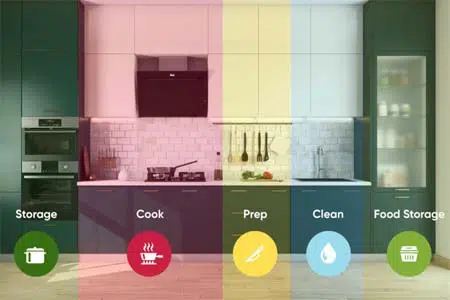
5 Kitchen zones are defined areas where related tasks take place. Think about your kitchen a workshop with logistical zones, everything in its place for optimum efficiency. Each zone has a specific task, and by keeping associated items together in these zones. Your cooking no longer feels like a marathon but a well-organized process.
The Pre Zone
The Pre Zone is where you get your food ready to cook. This is where you chop goods, mix ingredients, and do all the prep work. To organize this zone, Keep your mixing bowls, chopping boards, and knives close by. You might also want to have your spices and measuring cups in this area.
Where to put it: You can set up your prep zone between your refrigerator and sink. This gives you access to foods and water for washing easily. If you have counter space near these areas, that’s your prep zone.
Personal advice: I often keep a tiny trash bowl on my prep counter during cooking. Not only it saves countless trips to the main trash can, but also keeps vegetable scraps contained. Also, store your most-used knife on a magnetic strip above this area for quick access.
The Non-Consumable Zone
The non-consumables zone is the part of the kitchen for tableware, bowls, pots, cups, pans, and plates. These are all the things you use to cook with and serve your food. When organizing your non-consumables zone, please place the items you will use frequently and keep those in easy reach, and the rest can be tucked away.
Where to put it: The Non-Consumables Zone will sit between your Cleaning Zone (dishwasher/sink) and your Prep Zone. This will give you a process where clean dish can go directly into the storage zone and into the prep area for serving.
Personal experience: I keep my everyday dishes as low as possible and put my holy grail pieces up high. I also keep my coffee mugs by the coffee maker (this breaks the zone rule, I know!), but improves the efficiency in the morning, which will be more important than a well-organized zone.
The Cleaning Zone
The cleaning zone is where you wash your dishes and store your kitchen cleaning stuff. This might include a dishwasher, and cabinets for storing soap, sponges, and towels.
Where to put it: Your cleaning zone forms naturally around your sink and dishwasher. The cabinet under the sink usually becomes cleaning supply central.
Personal tip: Spray bottles can be hung from a tension rod beneath the sink. It doubles your storage space and keeps everything visible. I also keep a small basket near the sink for dirty dish towels – they get washed with the next load instead of cluttering the counter.
The Cooking Zone
The cooking zone is where you do the actual cooking, using your stove, oven, or microwave. This is where you bake, boil, or fry your food.
Where to put it: The cooking zone naturally forms around your stove and oven. Use the cabinets directly above and below these appliances for storing cooking items.
Personal tip: I installed a small shelf next to my stove for oils and everyday spices. Having salt and pepper within arm’s reach of the stove changed my cooking game completely. For pots and pans, use cabinet organizers to stack, and you will easily be able to pick them up and store them.
The Consumable Zone
The Consumable Zone is where you keep your food and drinks. This includes your refrigerator, freezer, and pantry.
Where to put it: If you have a pantry, that’s your main consumable zone. Otherwise, designate specific kitchen cabinets for food storage.
Personal tip: Sort things by meal type. I keep breakfast items together (cereal, oatmeal, coffee), dinner ingredients together (pasta, rice, sauces), and snacks in their own section. Clear containers work great for bulk kitchen items—you can see when you’re running low.
How to Set Up Your Kitchen with the 5 Zone Method
Step 1: Ask Yourself Which Zones You Need
Determine your kitchen layout first. Is it U-shaped, L-shaped, or galley style? Each layout has natural zones based on appliance placement.
Then, consider how will you use your kitchen. Do you have kids who like to help with cooking? Do your pets require a separate area when you’re cooking? Do you like to have friends over while you cook? Based on your answers, you can decide which zones are most important for you.
For example, if you have kids, you might want to create a small area in the Pre Zone where they can join the cooking with you for simple tasks like mixing or measuring.
Step 2: Store Items Near Their Zone
Once you’ve decided on your zones, start putting things in their proper places. For example:
• Keep your knives and cutting boards in the Pre Zone.
• Store your pots and pans in the Cooking Zone.
• Place your dishes in the Non-Consumable Zone near the Cleaning Zone.
This way, everything is where you need it, and you don’t have to search for items when you’re cooking.
Step 3: Place Your Prep Space Near the Stove
Try to set up your pre-zone close to your cooking zone. That way, you can easily move from chopping foods to cooking them without having to walk across the kitchen. This improves cooking efficiency and saves time.
In my kitchen, my cutting board is right next to the stove, so I can chop and cook without taking extra steps.
Step 4: Put Non-Consumables Near the Cleaning Zone
Keep your dishes, pots, and pans near the Cleaning Zone. This way, when you’re done cooking, you can quickly put them in the sink or dishwasher without having to carry them far.
I have a cabinet above my dishwasher where I store my everyday dishes. This makes it easy to unload the dishwasher and put things away.
Zone Method for Different Kitchen Sizes
Solutions for Small Kitchens
Small kitchens necessitate making zones overlap effectively. You may not definitively have five avenues in a kitchen, but certainly, you can cluster things by their function.
You have the following tips to guide you when developing zones in a small kitchen:
- Try to use vertical storage methods
- Hanging pots from ceiling storage
- Consider use multipurpose tools
- Using cabinet doors for storage
Thoughts for a Large Kitchen
In a large kitchen, you have the ability to create different zones and to have secondary zones. You may have two food prep zones separate from your cooking zone, or you may have a baking zone that is also separate from your cooking zone.
When outlining zones in a large kitchen, think about the following:
- Think in terms of zones on kitchen islands.
- Establish zones for beverage stations.
- Set aside zones for baking zones.
- Incorporate duplicates of any 1 item in multiple zones.
- Use walk-in pantries to create pursuing zones for storage.
Conclusion
Now, starting to organize your kitchen with the 5-zone method can make cleaning and cooking a lot easier. By dividing your kitchen into zones and keeping things in their proper places, you can lessen tension and save time. Try it out and see how it suits you!
Have no idea how to do? Contact AJ Flying Home to design an efficient kitchen for you.
People Also Asked:
1. How Can I Choose What to Put in My Kitchen?
Make a list of the things you use most frequently and keep them handy. For example, keep your coffee mugs near the coffee maker or your baking sheets near the oven.
2. How Do I Arrange Food in the Kitchen?
In the consumable zone, sort similar items together. For instance, keep all your breakfast foods in one area, your dinner ingredients in another area, and your snacks in a separate spot. You can use baskets to make your things organized. For more tips, see our article on walk-in pantry vs pantry cabinet.
3. How Do You Organize a Kitchen for ADHD?
If you have ADHD, it can be helpful to keep things simple and tidy. Try to use clear containers; you can see what’s inside, and label everything so you know where it goes. Keep only the necessities in each area and try to keep clutter to a minimum.
4. Where Should I Put a Refrigerator in a Kitchen Design?
The refrigerator is part of the consumable zone, so you have to place it in a place that you can easily access. Ideally, it should be near the entrance to the kitchen so you can grab food quickly. It should also be close to the pre-zone so you can easily get food when you’re cooking.
 English
  German
  French
  Spanish
  Portuguese
  Turkish
  Dutch
Dutch