
As you begin a kitchen renovation, you may have your mind run ahead: What color will the cabinetry be? The style of hardware? What material for the countertops? Although there is no doubt these aesthetic decisions are important, the success of your kitchen’s design depends heavily on one less distinctive—but far more critical—How deep are kitchen cabinets?
This single dimension will affect everything from ergonomics and flow to appliance choices and countertop installation. It will be our goal in this expansive guide to teach you all about cabinet dimensions. We will detail the accepted standard cabinet depths, an explanation of why they are what they are, and specific scenarios in which you might need to vary from standard dimensions. By the time you finish, you should have all of the necessary knowledge to confidently and accurately plan your kitchen layout.
Understanding Standard Cabinet Depths for Your Kitchen
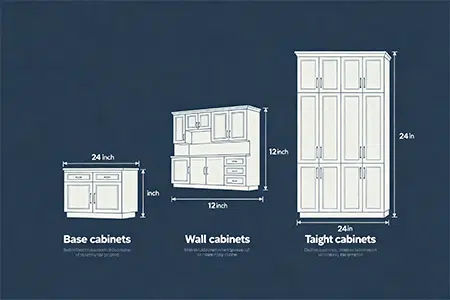
While the world of kitchen design offers nearly limitless custom possibilities, the vast majority of cabinets are built to a set of industry standards. These standards have been developed over decades to ensure compatibility between different manufacturers, streamline the installation process, and, most importantly, create a comfortable and efficient working environment for the user. Knowing these measurements is the first step in planning your layout. Let’s break down the typical cabinet depth for the three main types of kitchen cabinetry: base, wall, and tall cabinets.
Kitchen Base Cabinet Depth: The Foundation of Your Workspace
The kitchen base cabinet depth is the most important measurement in your entire kitchen layout. Kitchen base cabinets are the cabinets that sit on the floor. They provide the basic framework for your kitchen, and they support your countertop. All other measurements are usually derived from this one.
- Standard Depth
The normal depth of kitchen cabinets at the base is generally accepted to be 24 inches (about 61 cm). This measurement is taken from the back of the cabinet box (the part that is against the wall) to the very front of the box frame. This measurement does not include the thickness of the door or drawer front, which typically adds another ¾ to 1 inch to the overall dimension.
- Why 24 Inches?
This measurement is not arbitrary. The 24-inch measurement was intentionally picked to allow appliances to be installed by the cabinet. The depth of the kitchen base cabinets is intended for standard dishwashers, slide-in ranges, and trash compactors to be made flush with the cabinets to get that seamless integrated look that professional designers use. The 24-inch depth provides a substantial and comfortable amount of room for countertop workspace to be in front for food prep and more.
- The Crucial Countertop Overhang
A common point of confusion is the difference between the cabinet depth and the final countertop depth. Your countertop will extend beyond the 24-inch cabinet box by about 1 to 1.5 inches on the front. This means your finished countertop surface will have a total depth of 25 to 25.5 inches from the wall. This overhang serves several vital functions: it protects the fronts of your wood kitchen base cabinets from spills and drips, it provides a small lip that can be used as a finger pull for handle-less designs, and it makes the workspace more comfortable by allowing you to stand closer without your body pressing directly against the doors.
- Don’t Forget the Toe-Kick
At the very bottom of a base cabinet is a recessed area called a toe-kick. This is also a standardized dimension, typically 4.5 inches high and recessed 3 inches from the front of the cabinet box. Its ergonomic purpose is to allow you to stand comfortably and closely at the counter without stubbing your toes, improving your balance and reducing back strain.
Wall Cabinets: What’s the Typical Cabinet Depth?
Wall cabinets, also referred to as ‘uppers,’ are mounted to a wall above your base cabinets and have different depths. The purpose of wall cabinets is to give you a safe and functional kitchen space.
- Standard Depth:The typical cabinet depth for standard wall cabinets (uppers) is twelve inches (about 30cm). Had these cabinets been the same depth as the base cabinets, you would not have been able to see the countertop and would have posed the risk of striking your head while working. The twelve-inch depth gives you adequate storage dimensions, but also gives you a functional and open workspace area on the countertop that you can access from all directions. The distance is an ideal minimum for items such as a standard 10.5-inch dinner plate with other dinner plates, glassware, mugs, and pantry essentials.
- Common Variations:While 12 inches is the most common of the standard cabinet depths for uppers, there are variations for specific situations. You can definitely find stock cabinets that are 15, 18, or 24 inches deep. The most typical application of a deeper wall cabinet than 12 inches is over the refrigerator. When installing a twenty-four-inch deep cabinet over the fridge, the front of the cabinet is flush with the front of a ‘standard depth’ refrigerator, providing you with a clean, “built-in” appearance, and giving you deep storage that is accessible to store `bulky` items like serving trays or seasonal bakeware.
Pantry and Tall Cabinet Depths
Tall Cabinets usually consist of floor-to-ceiling pantries, oven cabinets, or utility cupboards that generally adopt the depth conventions established by the application cabinet they are associated with. The tall cabinet’s role is to integrate major appliances and provide the most vertical storage.
- Standard Depth: A full-height pantry cabinet or cabinet to contain a wall oven and microwave is about 24 inches deep to continue a clean, unbroken line with the rest of the kitchen. This gives a proper alignment with the kitchen base cabinet depth and an seamless appearance. This also provides ample depth space for installing the majority of standard wall ovens.
- Shallower Depths: In some applications, a shallower tall cabinet can be a brilliant solution. A pantry at 12 inches deep would be an ideal example in situations where the kitchen is small, walkways are tight, or in a butler’s pantry as an additional storage unit. The key advantage of a shallower pantry is visibility; items and food don’t get buried in the back, so they won’t be wasted, and you can see what you’re inventory is at a glance.
When to Change The Normal Depth of Kitchen Cabinets
While standards can provide a great framework, the best kitchens are designed around your needs and space. There are situations where you may “break the rules” and use custom or non-standard depth cabinets.
1. Oversized and Pro-Style Appliances: The trend toward pro-style appliances in residential kitchens will undoubtedly have us modifying standard depth cabinets. A 48-inch pro-style range might have a depth of 27 inches to 30 inches. A large capacity refrigerator can be 30 inches to 36 inches deep…In order to avoid these appliances sitting out a few inches from your countertop, you can specify deeper base cabinets (27 inches deep for example), creating a more seamless integration.
2. Islands and Peninsulas: Islands are the best location for modifications or customization. You can generally use a standard cabinet as a guide, and an island is generally deeper than a standard 24-inch deep cabinet. If you plan on using your island for seating, you will need to keep in mind the necessary knee space. Typically, it is recommended to have a minimum 15-inch overhang for comfortable counter height seating, based on the requirement of 27-30 inch cabinets, a comfortable 39-inch deep island top. For maximum storage, you can use two 24-inch deep cabinets back to back to create a 48-inch deep island base. This ensures maximum surface area for the work surface and maximum storage with a cavernous interior!
3. Accessibility and Universal Design: For homeowners in need of wheelchair accessibility, it is important to follow ADA (Americans with Disabilities Act) requirements. When those requirements are followed, it will typically involve more shallow base cabinets to provide flexibility with the space. You must make it clear that the under-the-sink cabinet, in addition to the cooktop cabinet, is accessible to the knees and provide a comfortable reach to the back of the countertop.
4. One-of-a-Kind Room Configurations and Limitations: Not every kitchen is perfectly square. A narrow galley, for example, would greatly benefit from the use of shallower base cabinets (18 or 21-inch depth) on one side to open up the central walkway and mitigate traffic flow. You are sacrificing storage and/or counter surface, but it can help the functionality of the space significantly.
Ultimately, knowing how deep a kitchen cabinet is is an essential piece of the design equation. Once you understand these standard dimensions and what to do to modify them, you are not simply selecting boxes; you are creating a functional, comfortable, and beautiful heart of your home. Go ahead and refine your plan, now that you know the details, and don’t hesitate to customize for a kitchen that works just right for your family.
FAQ
- Can I use deeper wall cabinets, like 15 or 18 inches?
Yes, you absolutely can, but it takes some planning. If you installed deeper wall cabinets (say 15 inches deep) above standard base cabinets (24 inches deep), it creates a foreboding feel and may create less usable space when working on the countertop. One way to solve that is to install deeper base cabinets (for example, 27 inches deep). That gives you a nice visual or physical clearance between your head and the upper cabinet when working at the counter.
- Do frameless cabinets have a different depth than framed cabinets?
The external cabinet box depth is the same—typically 24 inches for base and 12 inches for wall—regardless of whether the cabinet is framed or frameless. The difference is construction and interior space. Framed cabinets have a face frame that the doors are attached to, slightly reducing the opening size. Frameless (or “Euro-style”) cabinets have doors that mount directly to the sides of the cabinet box. This offers full, unobstructed access to the interior and a slightly larger storage capacity within the same external footprint.
Related Resouce:
Do 15″ or 18″ deep RTA cabinets exist? ——Reddit :rcabinetry
 English
  German
  French
  Spanish
  Portuguese
  Turkish
  Dutch
Dutch