
Mixing metals in the kitchen is easy; however, hundreds of homeowners make their kitchen metal mistakes, which is they’re trying to match everything perfectly.
In this guide, we’ll tell you how to mix metals in the kitchen to match everything in a balanced way, not compete with each other.
4 Fundamental Principles for Combining Kitchen Metals
Pick Your Dominant Metal first:
Sixty to seventy percent of the metal in your kitchen should be covered by your main metal. This contains:
- Cabinet hardware (handles and knobs)
- Lamps
- Faucets
- Bar stools
Selecting your dominant metal is done as follows:
- Start with your appliances.
- Think about your cabinet color.
- Consider the amount of illumination your kitchen receives.
Example: Chrome or stainless steel makes very good dominating metal if you have stainless steel devices. If you have white cabinets and lots of natural light, brass or gold can be your main choice.
Add One Contrasting Secondary Metal
Your secondary metal should make up 20-30% of your kitchen metals. This metal should be sufficiently unique to grab interest but not so distinctive that it seems incorrect.
Smart secondary metal choices:
- If your dominant metal is brass: Experiment with stainless steel or matte black.
- If your dominant metal is stainless steel: Try brass or copper
- If your dominant metal is black: Try brass or brushed nickel
My own experience: Define several spaces with your secondary metal. Put brass pendant lights over your island while keeping stainless steel everywhere else. This creates zones in your kitchen.
Use Complementary Metal Tones
Metals fall into three groups:
1. Warm metals make your kitchen feel cozy:
- Brass
- Copper
- Gold
- Bronze
2. Cool metals make your kitchen feel modern:
- Stainless steel
- Chrome
- Silver
- Nickel
3. Neutral metals work with everything:
- Matte black
- Cast iron
4. The mixing rules:
- Warm + warm = always works
- Cool + cool = always works
- Warm + cool = works if you’re careful
- Any metal + neutral = always works
Vary Your Metal Finishes
Most people become confused here. You can alter the appearance of the same metal type.
Common finishes and when to use them:
| Finish Type | Best For | Cleaning Need |
| Polished | Faucets, appliances | Daily wiping |
| Brushed | Cabinet hardware | Weekly cleaning |
| Matte | Light fixtures, decorative items | Low maintenance |
| Hammered | Sinks, decorative bowls | Hides water spots |
Example combination: Brushed brass cabinet handles + polished brass faucet + matte brass pendant lights. Same metal, three different looks.
Understanding Kitchen Metal Categories
1. Warm Metals for Cozy Kitchens
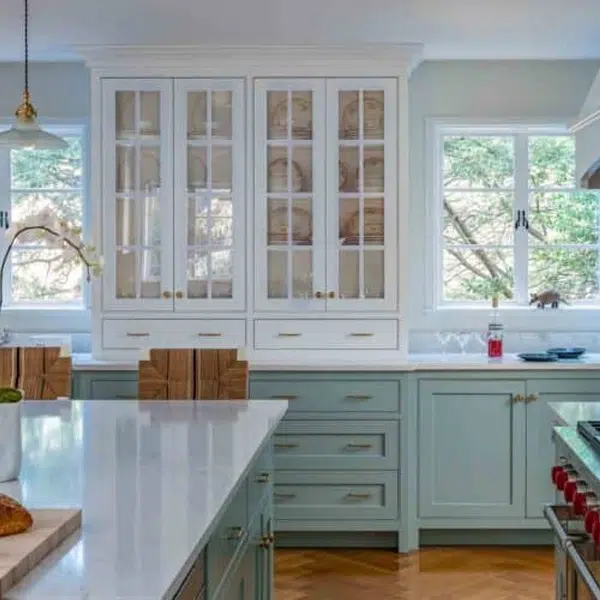
Brass is the most popular warm metal right now. As it gets older, it seems gold and becomes more lovely.
For brass works most effectively with:
- White cabinets
- Cream cabinets
- Natural wood
- Green cabinets
Copper’s orangered hue is ideal for rural kitchens. Pairs well with:
- Dark wood cabinets
- White subway tiles
- Natural stone counters
Gold is the most elegant warm metal. Use it modestly with:
- White or black cabinets
- Marble countertops
- Crystal or glass accents
2. Cool Metals for Modern Kitchens
Stainless steel:
Working with stainless steel is the simplest metal. It nearly matches everything and reveals fingerprints less than other metals do.
Chrome:
Chrome reflects light well and has a great gloss. It enhances the apparent size of little kitchens.
Brushed nickel:
Brushed nickel’s understated, matte finish conceals water spots. For hectic families, it works beautifully.
These cool metals work best with:
- Gray cabinets
- White cabinets
- Black cabinets
- Quartz countertops
Neutral Metals for Any Kitchen
Matte black:
The simplest metal to combine is matte black. Never appears wrong; it collaborates with all other metals.
Cast iron:
Cast iron gives any kitchen design personality with its coarse texture.
Why neutral metals are so useful:
- They connect warm and cool metals
- They don’t compete with other finishes
- They work in traditional and modern kitchens
Metal Finishes That Change Everything
Matte finishes don’t reflect light. They hide fingerprints and water spots better than shiny finishes.
Polished finishes are very shiny and reflect lots of light. They make kitchens feel brighter but need more cleaning.
Brushed finishes have tiny lines that catch light softly. They’re the easiest to keep clean.
Hammered finishes have small dents that create texture. They’re great for hiding scratches and spots.
Proven Mixed Metal Kitchen Combinations
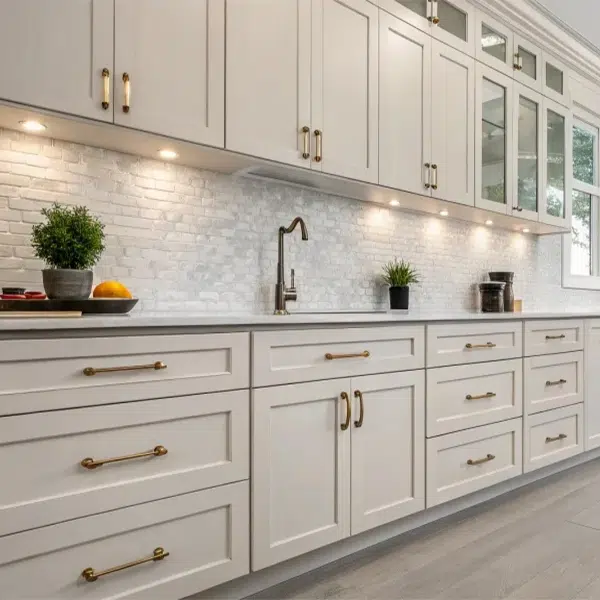
White Cabinets with Warm Brass Accents

This combination never gets old. Here’s how to do it right:
Your brass pieces should be:
- Cabinet knobs and pulls (60% of your metals)
- Pendant lights over the island
- Decorative bowl or tray
Keep these in a different metal:
- Faucet (try brushed nickel)
- Appliances (stainless steel is fine)
Why this works: Brass warms up the cool white cabinets without being too much.
White Cabinets with Matte Black Hardware

Black hardware makes white cabinets look crisp and modern.
Your black pieces:
- All cabinet hardware
- Light fixtures
- Bar stool frames
Add a warm accent:
- Brass or copper faucet
- Gold picture frames
- Wooden cutting boards with brass handles
Brass Cabinet Pulls with Bronze Pendant Lights

This keeps you in the warm metal family while adding interest.
How to make it work:
- Use unlacquered brass for cabinet hardware
- Choose oil-rubbed bronze for hanging lights
- Add copper accessories like canisters or planters
The key: Both metals have the same warm undertone but different surface textures.
Mixed Warm and Cool: Brass with Polished Nickel

This is an advanced combination that looks expensive when done right.
The ratio that works:
- 70% brass (cabinet hardware, some lights)
- 30% polished nickel (faucet, some appliances)
How to tie them together:
- Use white or cream cabinets as your base
- Add natural wood elements
- Include some matte black accents
Three-Metal Success: Black, Chrome, and Brass

Here’s the formula:
- 50% matte black (cabinet hardware, some lights)
- 30% chrome (faucet, appliances)
- 20% brass (pendant lights, decorative items)
Why this works: Black acts as a neutral that connects the warm brass and cool chrome.
Common Metal Mixing Mistakes to Avoid
- Using too many metals. I’ve seen kitchens with five different metals. It looks messy and expensive to fix.
- Forgetting about appliances. Your refrigerator, dishwasher, and range are part of your metal mix. Don’t ignore them.
- Matching everything exactly. Perfect matching looks flat and boring.
- Choosing metals that fight each other. Warm brass and cool chrome can work together, but you need a plan.
- Not considering your lighting. Some metals look different under warm lights versus cool lights.
How to Test Your Metal Combinations
Before you buy anything, try this simple test:
- Get samples of each metal you want to use
- Put them on your counter in natural light
- Look at them in the morning and evening
- Ask yourself: “Do these metals make me happy?”
Another efficient way is to ask the supplier to offer you a 3D design to check out them. If any metal looks wrong, swap it out. Trust your eyes.
Final Thoughts
Mixing metals in your kitchen isn’t scary when you follow these simple rules. Start with one dominant metal, add one contrasting accent, and limit yourself to three metals total. Your kitchen will look more interesting and expensive without breaking your budget.
But please start small. Change your cabinet hardware first. This is the cheapest way to test a new metal combination.
Frequently Asked Questions
1. How Many Metals Can You Mix in a Kitchen?
Sticking to a maximum of 2 or 3 metals. More than three metals gives your kitchen a disorganized appearance.
Good Mix:
Two metals: 70% dominant, 30% accent
Three metals: 60 percent dominant, 25 percent secondary, 15 percent accent.
2. Why Should You Blend Metal Finishes in a Kitchen?
Mixing metals gives your kitchen visual depth. Your kitchen appears lifeless and uninteresting when everything aligns precisely.
Additional advantages:
- Makes your kitchen appear to be more costly.
- Lets you personalize your environment.
- Aids in the demarcation of several spaces in open kitchens.
- Increases your shopping alternatives.
3. Are appliances of stainless steel considered to be a metal finish?
Yes, certainly. Usually the largest metallic surfaces in your kitchen are your appliances.
Stainless appliance working guidelines:
- Count them like your cool metal.
- Add warm metal accents to restore equilibrium.
- Think panelready appliances if you wish to conceal the stainless steel.
4. Gold and silver in kitchen design: Can you mix them?
Gold and silver are at different ends of the spectrum of metals; thus, you need to be cautious.
How to get it working:
- Matte black bridges them; use it.
- One metal should be kept as a little accent—20% or less.
- Choose matte or brushed surfaces over polished.
- Add natural materials like wood to reduce the contrast.
Example: Mostly brushed nickel (silver family) with tiny gold accents in a decorative bowl and picture frames.
 English
  German
  French
  Spanish
  Portuguese
  Turkish
  Dutch
Dutch