
Introduction
You may be confused about the differences between inset and overlay cabinets before placing an order with the supplier. This guide will comprehensively discuss their pros and cons and compare them in design, cost, durability, etc, which will be useful to help you make a smart decision. Let’s completely analyze the inset vs overlay cabinets.
Definition and Design Characteristics Difference
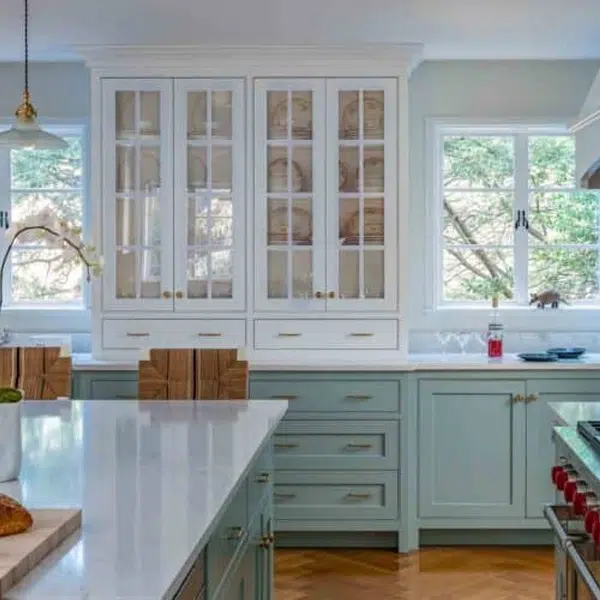
Inset cabinets are a classic and traditional style of cabinetry in which the door panels or drawers are set flush within the cabinet frame, you can find the hinges or other hardware easily inside or outside. They offer a high-end and timeless look for your kitchen.
However, overlay cabinets are different from inset cabinets, their doors and drawers sit on top of the cabinet frame to cover the cabinet frame, this kind of cabinet is created to match a modern kitchen in a seamless design.
Compare Their Types
Types of Inset Cabinet Door
1. Inset Shaker Style:
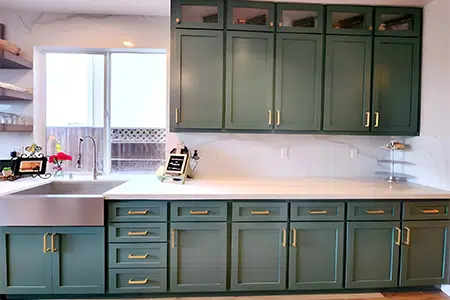
The Inset shaker cabinet means that the door is designed with a flat center panel and a slightly raised frame around it. This type of cabinet works well with both traditional and transitional kitchens.
2. Beaded Inset Style:
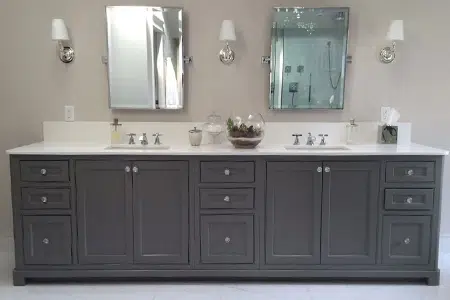
The style of beaded inset cabinets are a good choice for traditional and cottage-style kitchens because they can add a touch of elegance by featuring with a small and decorative bead detail carved into the door panel.
3. Raised Panel Inset Style:
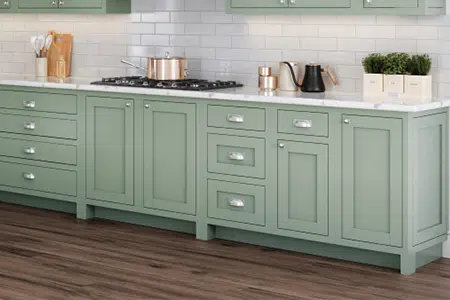
The raised panel door cabinet looks like you embossed a square or oblong elevated shape on the center of the door panels. They’re often used in formal or traditional kitchens with depth and dimension touching.
4. Arched Inset Style:
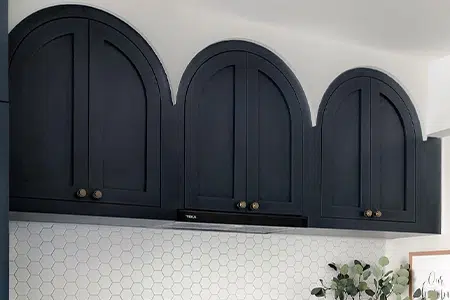
As you can see, there’s an arched-shaped door on the inset cabinets. This kind of door gently curved top edge on the door panel offers your kitchen a softer and more rounded touch. You can often find them in traditional and classic kitchens.
5. Glass Front Style:
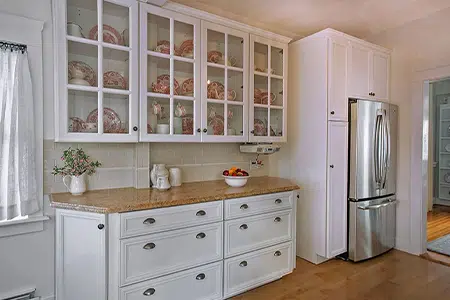
Glass-front inset cabinet means that the doors are made of glass panels, you can create them with clear glass to allow your kitchen stuff to be shown neatly arranged. Or you can use obscure glass to hide disorganized kitchen supplies. They work well in both traditional and modern designs.
6. Mullion Inset Style:
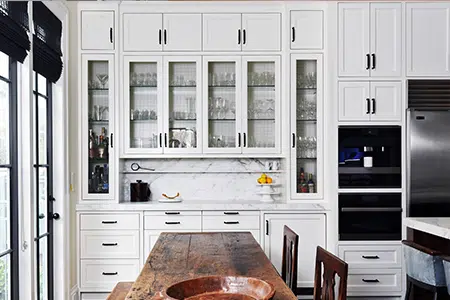
Mullion inset-style cabinets feature glass with gridwork to wooden cabinet frames and the grids are customized in any shape or style. This type of cabinet is attractive with visual interest, and you can often find them in both traditional and farmhouse-style kitchens.
Types of Overlay Cabinets
1. Full Overlay Cabinet Doors:

Full overlay cabinet doors or drawers are completely cover the cabinet frame, and there only leaves slight gap between adjacent doors and assembled by hidden hinges to create a seamless and modern appearance, while maximizing the storage space of the cabinet
2. Lipped Overlay Cabinets:

The design of the lipped overlay cabinet is between the standard inset and the overlay cabinet. You can imagine that the door partially sits over the cabinet frame but also has a distinct “lip” cut into the edge of the door, allowing part of the door to sit inside the cabinet frame.
3. Partial Overlay
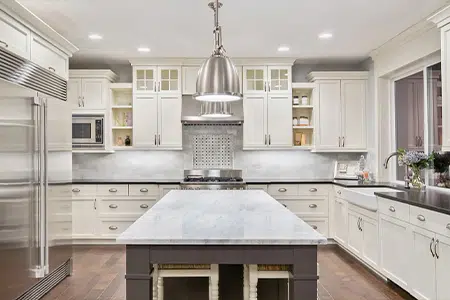
As the name suggests, partial overlay cabinets’ doors or drawers only cover part of the frame of cabinets, and you can notice a visible gap from this design between doors or drawers. Typically, it is used in classic or transitional kitchen spaces.
Compare Their Pros and Cons
Pros of Inset Cabinets
- Flush and Sleek Appearance: The Inset cabinet’s doors are aligned with the cabinet frame, creating clean and simple lines, they’re a good idea for a shaker or craftsman-style kitchen.
- Hidden or Visible Hinges: We often use visible hinges to offer your inset cabinet a vintage and decorative touching, you can also choose hidden hinges to create a modern and stylish look.
- Precision and Detail: Inset cabinets require the fabricator to pay more attention to the dimension and their craftsmanship, otherwise, they are not able to tight fit making inset cabinetry slightly more durable.
Cons of Inset Cabinets
- Limited Space: Inset cabinets’ doors are to be set inside the frame, and frame thickness is usually around ¾ of an inch, which means the width and height of the cabinet have been reduced. Result in a limited storage area.
- Style Flexibility: You can customize the inset cabinet in different ways. However, an inset cabinet is born for a traditional style kitchen space, because they offer clean lines, and visible hinges and are built to fit flush with the cabinet frame. They’re not a good idea for a minimalist modern style.
- Cleaning Problem: There’s a small gap between the door and the cabinet frame, which allows this kind of gap is easily trap dust and crumbs. Moreover, the exposed hinges will be hard to clean when it is used in the kitchen or bathroom where humidity and grease are more common.
- Humidity Woes: Wood naturally contracts or expands with relative humidity and temperature. Because inset cabinet doors and drawers fit so snugly within the frame, even a small amount of expansion creates a situation where doors and drawers may stick or rub against that frame, thus becoming extremely difficult to open or close, and friction damage.
Pros of Overlay Cabinets
- Streamlined Look: Overlay cabinet doors are connected tightly and continuously, offering you a uniform and seamless look.
- Concealed Hinges: Overly cabinets, especially full overlay use concealed hinges to let the front of cabinets look sleek and uninterrupted.
- Enough Storage Space: The entire cabinet space is freed up for storage as overlay doors sit on top of the cabinet frame rather than inside it.
Cons of Overlay Cabinets
- Alignment Challenges: You will find obvious misalignments if the full overlay cabinets are not installed carefully with precise alignment, and it will be noticeable due to the close positioning of the doors and drawers.
- Wear and Tear: The edge of the door or drawer is located at the top of the frame. Frequent opening or closing will inevitably cause friction with external objects, resulting in wear and tear.
- Limited Customizable: There’s limited customization for overlay cabinets, to reach a seamless and smooth look, you’re not able to customize them with moldings, trims, or other custom decorative elements.
Cost Differences:
Inset cabinets are around 15% – 25% more expensive than overlay cabinets, as inset cabinets require precise craftsmanship to fit the doors and drawers into the cabinet frame, which makes the labor cost increase a lot. However, overlay is simpler in construction, and they require less labor cost.
Style Difference
Inset cabinets combine quintessential craftsmanship with clean lines; they are popularly selected in traditional, shaker, and transitional kitchens. The overlay cabinets provide more choice of styles, with partial pull providing a more traditional feel, and full pull providing an upscale, modern look that would grace any contemporary setting.
Compare Durability
An overlay cabinet is more durable than an inset cabinet. The inset cabinet door will rub against the frame over time caused by wood expansion or contraction if it is under a high-humidity condition. However, the frame of the overlay cabinet is protected by its door panel, which makes it durable in high-traffic kitchens,
Installation Difference
The inset cabinets, for their part, can be rather complicated and demand very competent and precise work to make sure the doors align with each and every frame, in distinction to the overlay cabinets, which are more forgiving.
Conclusion:
You’ve known that inset cabinet and overlay cabinet have their strength. Whether to choose an inset or overlay style depends on your personal favorite, kitchen style, and budget. If you need any full house furniture service, AJ Flying Home is your best option, contact us now!
FAQs:
1. Whether overlay cabinets outdated?
An overlay cabinet is a classic cabinet that has been popular all the time. Whether it’s outdated or not in your mind, depends on your personal favorite, and whether matches your kitchen style.
2. Are inset cabinets timeless?
Inset cabinets are considered a timeless design, as they often are used for classic, traditional, modern, and high-end kitchens.
3. Do you lose space with inset cabinets?
The inset cabinet will lose some space, but it’s minimal. This is because the cabinet door is sit inside of the cabinet frame.
4. How much countertop overhang with inset cabinets?
Generally speaking, it is from 1 to 1.5 inches.
Related Resouces:
What is an Inset Cabinet? – Julieblanner
Inset Cabinet Ideas – Pinterest
Full Overlay Cabinet Ideas – Houzz
Difference Between Shaker Style Cabinets Vs Flat-Panel Cabinets – AJ Flying
 English
  German
  French
  Spanish
  Portuguese
  Turkish
  Dutch
Dutch