
Introduction
What is edge banding? If you’ve ever seen a cabinet or shelf with rough sides, it’s likely missing edge banding. Edge banding is what makes furniture look clean, smooth, and complete. Without it, the raw board underneath—often made from particleboard or MDF—can chip or take in moisture.
This guide will completely talk about what is edge banding , the process, benefits, material options, and other considerations.
Definition of Edge Banding
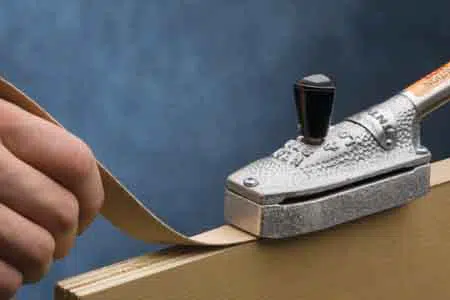
Edge banding is a thin strip of material that gets glued to the raw edges of boards. It is usually used on boards made from MDF, plywood, or particleboard. These boards are strong inside but rough and weak at the edges.
Edge banding helps in three ways:
- It seals the edge to keep water and dirt out.
- It protects the board from chipping or damage.
- It improves how the furniture looks.
Process of Edge Banding
Edge banding includes several significant steps in order to make sure the edge is tightly sealed and looks good.
1. Cut the Board: Cut the board to the shape and size you need.
2. Edge Preparation: Make sure the edge is clean and dry and dust-free. Some factories even pre-heat the edge to enhance the glue bond.
3. Put Adhesive: Depending on the method, it could be that the glue is already pre-applied to the banding material (iron-on, laser) and then you activate the adhesive, or that the hot-melt glue is applied using a machine.
4. Add Edge Banding: Press the edge banding to the edge of the board with rollers or by hand.
5. Trimming: Use a trimer or cutting blade to trim the overhanging edges to precisely flush to the surface of the board.
6. Buffing: Finally, the edge may be buffed or sanded to create a smooth blend with the board surface.
In an automated edge banding solution, the machine uses machines to accomplish these processes quickly. For small DIY tasks, these steps can also be completed with a handheld tool or even using a household iron!
Edge Banding Benefits
Functionally:
- Prevents moisture from penetrating the board.
- Adds strength to the edge and makes breaking/chipping the edge more difficult.
- Keeps dust and dirt out of the board core.
Beautification:
- Creates a clean look on furniture.
- Allows you to match the edge color with the surface color.
- Hides the rough edge of the inner material.
Material of Edge Banding
PVC
The most widely used is PVC. It’s affordable, comes in many colors and textures, and is very easy to apply, making it ideal for most factory and budget furniture. If you’re aiming for efficiency and cost control, PVC is usually the way to go.
PP (Polypropylene)
PP is an eco-conscious option, it’s free from chlorine and releases fewer emissions during production. PP is also tougher than PVC when it comes to handling heat and cleaning chemicals. But it can be a bit tricky to work with because it’s less flexible. I recommend PP if your furniture is going into kitchens or bathrooms, where moisture and heat resistance are a big deal.
ABS
ABS, think of it as a stronger, safer upgrade to PVC. It doesn’t contain chlorine and is more stable under heat and pressure. If you’re working on high-end or commercial projects, ABS might be worth the slightly higher cost. It’s also recyclable, good for environmentally minded customers.
Melamine
Melamine edge banding is another common choice, especially in lower-cost furniture. It’s made from paper soaked in resin and is very thin. While it’s great for lightweight interior components like shelves and drawer sides, I wouldn’t use it for visible or high-impact areas. It’s just not durable enough.
Wood Veneer
This is real wood, sliced thin, and backed with adhesive. Veneer gives the furniture a rich, natural look that plastic simply can’t replicate. It’s perfect for high-end cabinets or solid wood surfaces where you want to maintain the look of real timber. But it does take more time and care to apply. Veneer can crack or splinter if mishandled.
Common Methods of Edge Banding
1. Hot-Melt Glue
- The most foreseen industrial application method of applying edge banding.
- A machine applies melted EVA or PUR glue to the board and then presses on the edge banding.
- The quickest, strongest application with a high degree of reliability.
2. Laser or Hot Air edge banding
- This application does not use any glue. the machine melts a special layer on the banding bagging using either hot air or laser.
- Good for a seamless look and better water and heat resistance.
- The are much more expensive, however, they have become fairly common for high-end cabinetry.
3. Iron-On Edge Banding
- This method is great for smaller jobs or a homeowner.
- The edge banding comes with the glue already applied, you only need to heat it up to activate the glue.
- You will need a clothes iron and hand trimming tools.
- Very easy to do and doesn’t hold up as well as the factory applied applications.
4. Manual Contact Cement
- Apply a strong contact adhesive (contact cement) by hand to both the board and band.
- It is then pressed after being tacky.
- Works well for thick veneer or heavy-duty wood banding.
- Requires more time and skill to do.
Thickness of Edge Banding
| Thickness | Where It’s Used | Notes |
| 0.5mm | Inside parts of cabinets | Cheap and flexible |
| 1mm | Cabinet doors, visible edges | Stronger, better look |
| 3mm | Commercial furniture | Very thick, protects corners |
For example, if you’re building a kitchen island, use thicker edge banding on corners and door fronts.
Other Considerations
Peeling Issue
- The edge band could peel off if the glue has weak adhesive qualities and/or the surface is dirty.
- Another concern could potentially be heat or moisture.
This is why it’s important to use quality adhesives and do your proper prep work.
Cost
- PVC and melamine are the least expensive.
- ABS and wood veneer are an increase in cost.
Cost might matter more in situations like whole-house customization or large jobs.
Adhesives
- EVA glue is commonplace.
- PUR glue is more durable and more moisture-resistant.
Factory manufacturers of kitchen cabinets or bathroom cabinets will often use PUR as it handles moisture a little better than EVA. This means kitchen and bathroom vanity setups also receive PUR glue.
Conclusion
Although edge banding may be a small step in the overall furniture-making process, it makes a significant difference in the final furniture. Edge banding protects, enhances, and beautifies, while improving durability.
Whether you are working on a kitchen, wardrobe, or simply a shelf, edge banding assists in providing a longer-lasting and seemingly better-quality furniture final product. Edge banding should be applied if you are working with laminate kitchen cabinets or MDF kitchen cabinets.
Related Resouces
1. Types of adhesives – Threebondindia
 English
  German
  French
  Spanish
  Portuguese
  Turkish
  Dutch
Dutch