
Introduction
Cabinets sitting on countertop offer an “unfitted” style of kitchen that feels more like collected furniture than being purchased as a set.
In this guide, we will discuss the advantages and disadvantages of countertop cabinets, the available styles, applications, and some practical advice on how to incorporate these types of cabinets into your home.
What is a Countertop Cabinet?
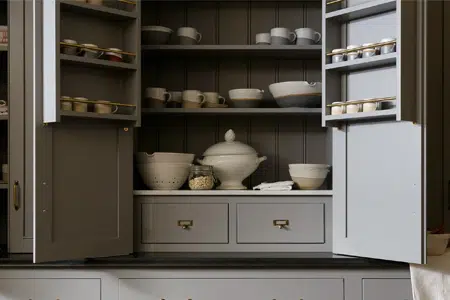
A countertop cabinet is an individual cabinet that is on top of a counter surface, rather than suspended from the wall.
Countertop cabinets are useful for anyone who wants to conceal a coffee pot or toaster, showcase beautiful glassware or dishware, or create an area dedicated to breakfast.
Pros and Cons of Countertop Cabinets
Pros
1. The Hutch Aesthetic
These cabinets make a statement like custom cabinetry. It’s not a row of matching cabinets, but something that adds interest. This is useful when you desire a look that’s not as ubiquitous.
2. Hidden Storage
Appliances can be stored in countertop cabinets. Your coffee machine, toaster, and mixer are staying plugged in and ready to use, but the doors provide a closed look when not in use. You have convenience without the visual clutter.
3. Accessibility
Things are at eye level, which is preferable than reaching for those items that are stashed up on high cabinets. You know what you have got, and there is no need to pull out the step stool to reach for that cup or plate you’re using every day.
4. Visual Weight
A countertop cabinet sits on the end of a line of kitchen base cabinets or fills an odd corner. It creates an interesting height variation.
Cons
1. Limited Workspace
Every square inch taken up by a cabinet means less space for food prep. If your kitchen is already tight on counter space, this may not be a good deal. Consider counter space versus storage.
2. Crowded Visually
The space in a small kitchen can feel limited, even more so by going vertical on the counter. The cabinet will block your view into the rest of the room, making it feel smaller. Think about your kitchen size before going ahead.
3. Risk of Damage
Improper installation may cause cracks in the countertop or cause uneven weight distributions, as well as allow for water to penetrate under the countertop through improper sealing. Either you should carefully follow the installation instructions or hire an experienced person to install it correctly.
Popular Styles & Variations
The Glass-Front Display
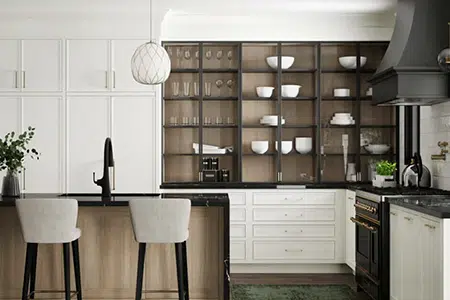
Glass doors create a display case for items stored inside. A glass door with mullion details works particularly well to display:
- Heirloom China is handed down from generation to generation
- Colored glassware collections
- Special occasion dishes that you would like to showcase.
The Appliance Garage
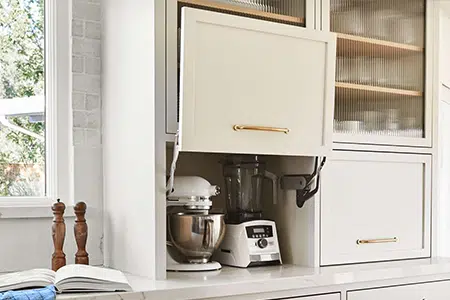
The appliances that you use every day can be disguised by solid cabinet doors. Bifold and pocket-style sliding doors are great because they don’t swing open out into the workspace, allowing for all appliances to stay plugged in and ready for use while creating an uncluttered appearance.
Often, these types of door cabinets are positioned close to either a coffee bar or breakfast nook. When visitors arrive, simply closing the door instantly tidy’s up a kitchen.
The Breakfast Station
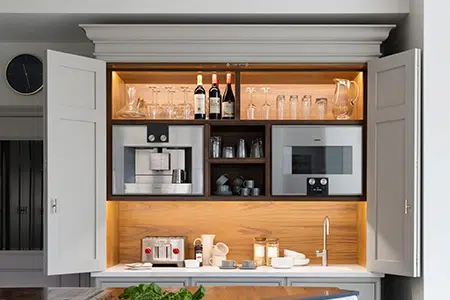
Busy families will find a designated area for the morning routine useful. By storing coffee, mugs, cereal boxes, and bowls all in one area, children can easily serve themselves rather than having to search for items in multiple cabinets.
In a U-shaped kitchen layout, you can set aside an entire counter area just for breakfast without interfering with the main kitchen work triangle.
The Corner Unit
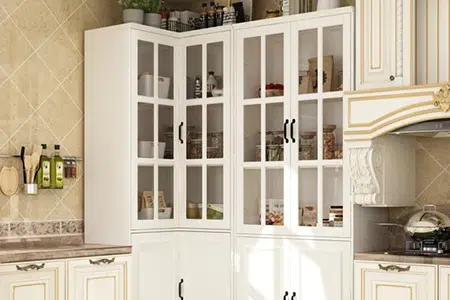
Dead corner areas are wasted space and a corner countertop cabinet can reclaim some of that area for use. Some corner cabinets are designed to have angled fronts to accommodate the corner angle, while others sit perpendicular and have open shelving on one side.
Corner cabinets can also be useful in L-shaped kitchen cabinets where the corner area naturally needs something to connect the two runs of cabinets together.
Design Considerations
Depth Matters
Countertop cabinets usually have a depth of 15-18 inches.
If your kitchen already has a tight counter height and depth, you should opt for a 15-inch cabinet. If you have some room to spare on either side of the cabinets, you can use the deeper cabinet.
Backsplash Integration
For your backsplash tile, you have two options: Back the tile by the cabinet or let it stop at the sides.
Backing the tile looks good when you later remove the cabinets. Stopping at the sides saves tile but creates visible edges. Think ahead on this option.
Electrical Needs
Plan outlets inside the cabinet if you’re storing appliances. Coffee makers, toasters, and mixers need power. Tucking cords in the cabinet and running them out to a wall is counterproductive.
Lighting
Glass front cupboards require interior lighting to bring out the items on display. Puck lights on the upper side spotlight the shelf surface. LED tape lights on the side emit a diffused light.
Battery lights are convenient for temporary features, while plug-in or hardwired lights do not require battery replacements. Ensure your choice of lighting complements your under cabinet lighting if you have one.
Expert Tips for a Professional Look and Usage
Hardware Choice
Use a hardware style that is different from your cabinetry for your countertop cabinet to make it look like furniture. If you have modern bar pulls on the cabinets, consider going for vintage knobs.
The contrast tells people that this cabinet has a purpose. Refer to cabinet knobs vs pulls to get an idea of how a different hardware style can look.
Crown Molding
Have crown molding from the top of the countertop cabinet to the ceiling. This makes the cabinet look built-in instead of a later addition. The molding creates a visual link to the room.
Ensure the profile matches with other molding around your kitchen.
Color Blocking
Paint or stain your countertop cabinet a color that contrasts to your other kitchen cabinets. Two-tone kitchens are pleasing to the palate.
A dark-stained countertop cabinet is an eye catcher against white shaker kitchen cabinets. Navy-blue or forest green paint demands attention. It pops and becomes the focus.
Size Considerations
Measure, measure, measure before you buy. Get those measurements down. Even if your cabinet’s one-half inch too wide, it won’t fit; you’ll be returned and exchanged. Standard kitchen cabinet sizes are guidelines. Always double-check your measurements.
Frame or Frameless
Framed construction gives a traditional look that is more suitable for shaker-style cabinets. Frameless is more for contemporary flat panel cabinets and slab kitchen cabinets.
You make this decision based on your likes and the cabinets you already have. Either of these styles works as long as it is constructed properly.
Consider Storage
Selection of shelving, drawers and storage compartments should be based on what you and your family will actually store in them and how often they will be used.
Daily used items should be located at the most accessible or convenient height. Weekly used items may be placed higher or lower.
Talk to your cabinet builder and see if they offer adjustable shelves in case your storage requirements change over time or increase in size.
Applications of Countertop Cabinets
Kitchen Uses:
- Store daily dishes and glassware near the sink
- Create appliance garages for small electronics
- Display collections or decorative items
- Organize spices and cooking oils
Bathroom Applications:
- Extra storage on vanity counters for toiletries
- Display area for decorative soaps and towels
- Medicine and first-aid organization
Laundry Room Storage:
- Detergent and cleaning supply organization
- Folded towel and cloth storage
- Stain remover and spot treatment access
Home Office Setup:
- Printer and office supply storage
- File organization at desk level
- Display space for books or awards
Bar Area Organization:
- Glassware display behind glass doors
- Liquor bottle storage with easy access
- Cocktail tool and accessory organization
Height
Countertop cabinets may be made as high as the ceiling, therefore utilising the area between the top of the cabinet and the ceiling that is otherwise considered dead space, i.e., dust collecting.
If you choose to build your cabinets all the way to the ceiling, you can choose to use a library ladder or have a step stool available for reaching the upper shelves of the cabinet.
Conclusion
Countertop cabinets can provide an element of character to your kitchen as well as improving your available storage options far more than wall-mounted cabinets can do alone. Try evaluating the current configuration of your kitchen cabinetry to find a hutch-style cabinet that might work in a corner or as an end piece to your cabinets.
Contact AJ Flying today to custom-build the perfect countertop cabinet for your space! For competitive pricing on countertop cabinets, you may also want to check out our factory in China.
 English
  German
  French
  Spanish
  Portuguese
  Turkish
  Dutch
Dutch