
It’s easy to make a narrow gallery look open and have more storage space if you follow our 5 fundamental design tips.
Before to learn about the fundamental design ideas, it’s better to learn some basic information about galley kitchen layout, it’s will be useful to help you design your kitchen.
What Mean of Galley Kitchen?
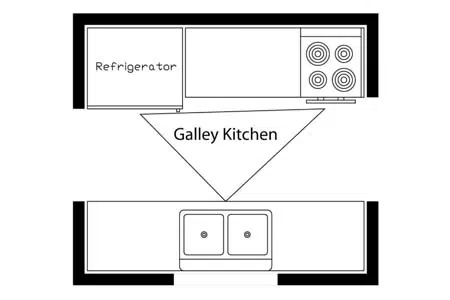
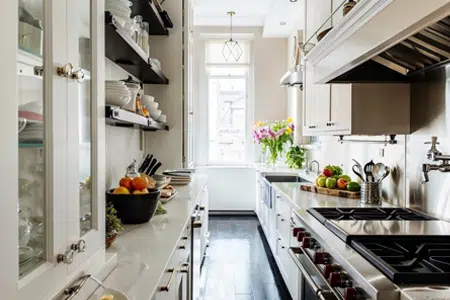
Think of a narrow and straight passageway, and both sides are lined with kitchen cabinets and other kitchen appliances; this is the layout of a galley kitchen. The name comes from ship kitchens, where space is tight and everything needs to be within arm’s reach.
Average Size of Galley Kitchen
Most galley kitchens are 7 to 12 feet wide. The walkway between counters should be at least 36 inches wide – but 42 to 48 inches works better if you have the space. This offers you enough room to open appliances and walk around without running into objects
Applications of Galley Kitchen
• Narrow spaces, such as apartments or condos
• Homes where the kitchen connects two rooms
• Small houses where you need to save space
• Rental properties that need simple, cost-effective designs
Advantages and Disadvantages of Galley Kitchen Layout
Advantages
- Everything is accessible. You can prep food on one side, then turn around to cook on the other side. No long walks between work areas.
- Lower cost to build. Galley kitchens require less materials than L-shaped or U-shaped layouts. You need less countertop, fewer cabinets, and shorter runs of plumbing and electrical.
- Easy to clean. With everything in a straight line, it’s easy to clean the whole kitchen quickly.
- Good for one cook. If you usually cook alone, a galley kitchen puts everything you need close at hand.
Disadvantages
- Limited counter space. You don’t have as much room to spread out when cooking big meals.
- Traffic problems. If people walk through your kitchen to get to other rooms, they’ll get in your way while you cook.
- Hard for multiple cooks. Two people cooking at the same time will bump into each other.
- Storage challenges. You have less cabinet space than in bigger kitchen layouts.
How to Design a Galley Kitchen
1. Planning Your Kitchen Triangle
The kitchen triangle connects your refrigerator, stove, and sink. In most kitchens, you want these 3 spots to form an efficient work triangle.. But galley kitchens are different.
In a galley kitchen, I recommend putting your main triangle of work on the side. Place your stove and sink on the same side, with your main prep area between them. Put the refrigerator on the opposite side.
This placement prevents you from crossing back and forth constantly while cooking. You can prep, cook, and clean all from one side of the kitchen.
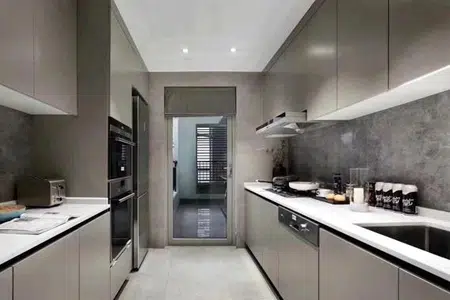
2. Arranging Appliances
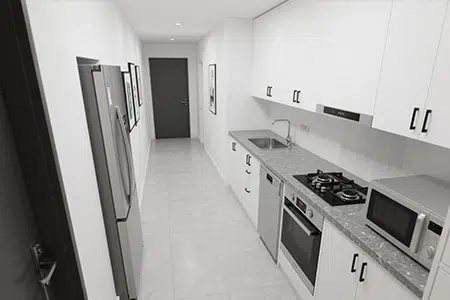
Follow the work flow rule. You can start with food storage (refrigerator), move to prep (sink and counter), then cooking (stove), and finally serving.
Keep busy appliances together. Put your microwave, oven, and main workspace on the same side. This prevents traffic jams when someone else walks through.
Choose integrated appliances. Built-in appliances look cleaner and take up less visual space. A counter-depth refrigerator won’t stick out into your walkway.
- Here’s my tried-and-true appliance arrangement:
- Refrigerator on one end
- Sink and dishwasher on the opposite side
- Stove and microwave on the same side as the sink
- Between the stove and sink is the main prep counter.
3. Place Shelves and Cabinets

Use symmetrical design. Your cabinets ate not necessary to match exactly, but they should feel balanced. If you have tall cabinets on one side, consider similar heights on the other side.
Go floor to ceiling. All cabinets give you much more storage than standard 30-inch wall cabinets. The extra height makes your kitchen look bigger too.
Mix open and closed storage. Open shelving makes the space feel spacious. Use open shelves for dishes you use daily. Put everyday items in closed cabinets.
I always tell my clients to think vertical. In a narrow kitchen, you need every inch of storage you can get.
4. Design Your Lighting System
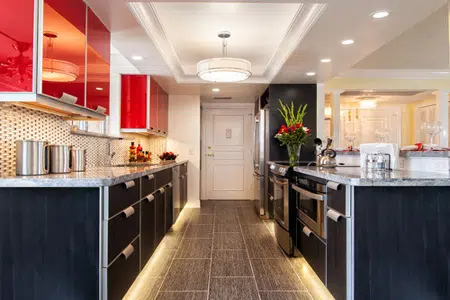
Well-designed lighting makes your galley kitchen look larger and work better.
1. Natural light first. Don’t block windows with tall cabinets or bulky appliances. Natural light makes any space feel bigger.
2. Add layered lighting. You need three types:
- Overhead lighting – recessed lights or a track light for general illumination
- Under-cabinet lighting – LED strips to light your countertops
- Accent lighting – To add flair, use ornamental fixtures or pendant lights.
3. Pay attention to task areas. Put extra light where you prep food and cook. Under-cabinet lights work great for this.
From my experience, most people don’t put enough light in their galley kitchens. Don’t make this mistake – bright light makes the space feel twice as big.
5. Color and Finish Selection
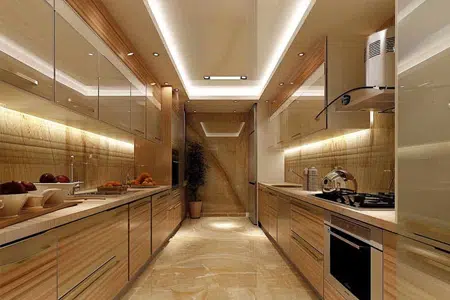
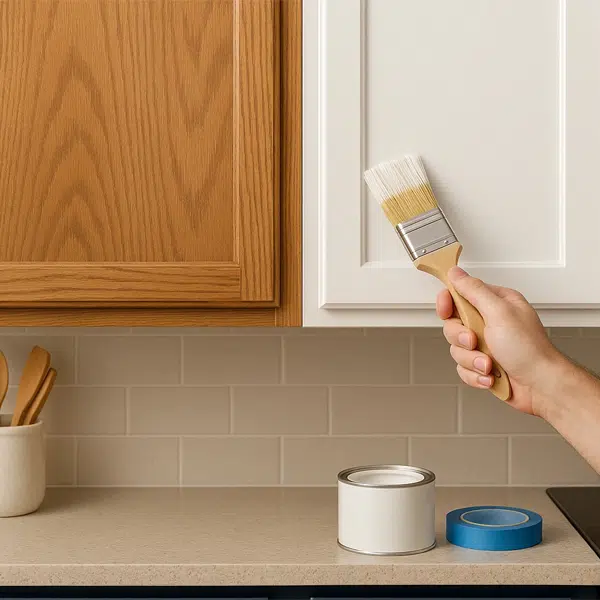
- Light colors make space. White, light gray, and cream colors reflect light, making your kitchen appear larger. Dark colors will absorb light and make spaces appear smaller.
- Try glossy finishes. High-gloss cabinet doors and countertops reflect light throughout the space. This makes your kitchen feel more open.
- Patterns can add depth. A patterned backsplash adds interest, but without taking up your space. Patterns like subway tiles, hexagons, or geometric work well with it.
- Consider a mirror. You can consider integrating a mirror cabinet door to double the visual space.. Place it opposite a window for the best effect.
I’ve seen dark galley kitchens that work, but they need perfect lighting to pull it off. Light colors are much safer for most people.
6. Door Type and Hardware
- Choose flat-panel doors. Raised-panel doors create shadows and visual clutter. Flat panels look cleaner and more modern.
- Go handle-free. Push-to-open doors and drawers save space and look sleeker. No handles to catch on clothing or bump into.
- Consider pocket doors. If your galley kitchen has doors at the ends, pocket doors slide into the wall instead of swinging open. This saves space and prevents blocking the walkway.
Final Thoughts
Now you’re able to make an open and more storage-filled gallery kitchen even if this type of layout has a narrow footprint if you focus on these five fundamental ideas: smart appliance placement, maximum storage, great lighting, space-expanding colors, and clean door styles.
Want to check out more ideas and get free design? Contact AJ Flying to have a pre-visual design before making an order
 English
  German
  French
  Spanish
  Portuguese
  Turkish
  Dutch
Dutch